
Speeches
ADDRESS BY CHAIRMAN OF COUCNIL OF MINSITERS AT TEH CENTARL EUROEPAN INITIATIVE SUMMIT
11/04/2011
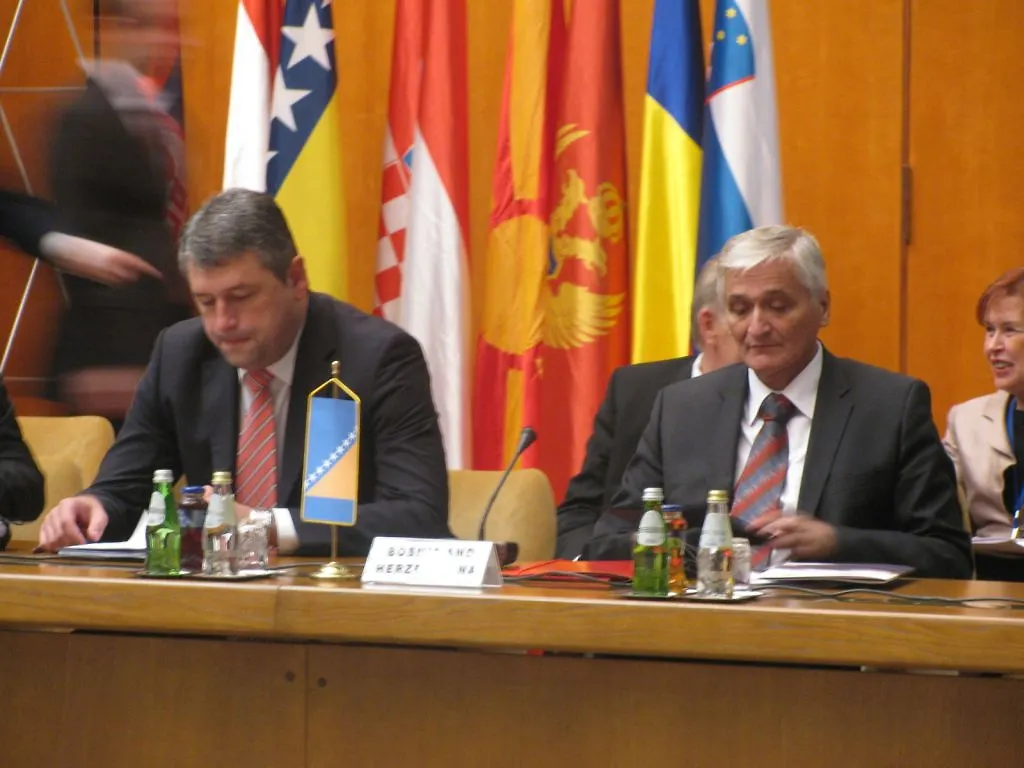
Vijeće ministara Bosne i Hercegovine
Dear Prime Minister Cvetković,
Dear Mr. Fancelter,
Distinguished Excellencies,
Ladies and Gentlemen,
It is my great honour to be here and express my gratitude for having a possibility to congratulate, on behalf of Delegation of Bosnia and Herzegovina, our hosts for organisation of this important gathering, as well as to greet all distinguished participants of the Central European Initiative Summit. I am convinced that today’s exchange of opinions will be a constructive one and will contribute to improvement of cooperation within the CEI, with a special focus on strengthening of competitiveness in the view of the common European future of member counties of the Initiative.
The central topic of the 12th Summit of CEI, held two years ago, was The Way Forward: Towards a Better Future. Overcoming the challenges addressed then continues to be very topical today, as the issue of economic crisis seems to gain new dynamics and new dimension. This is a reason more for us at this Summit to focus on the issues relevant to boosting of economic development, with competitiveness being certainly amongst them. For our discussion to gain relational outlines, the issue of competitiveness needs to be placed within the context of the European Integrations as a process in which the Initiative members take part in the capacity of EU member, EU candidate or potential EU candidate.
In respect to recently publicised enlargement package of the European Union, I must refer to its positive determinants. I congratulate to colleagues from Croatia, whose finalisation of the accession negotiations made the European prospect a reality. I am confident that this news will present one among central messages of the present forum, which is that the reform efforts always pay off. It is so not only for the sake of membership, bur for ourselves as well, for our internal changes to lead us to better conditions for economic activities, improvement of competitiveness and development of production capacities, which, in turn, increases GDP and improves living standard of citizens.
This message and news, as all good news from the region, namely a recommendation for opening of accession talks with Monte Negro and recommendation for awarding a candidate status to the Republic of Serbia, all give an additional incentive to Bosnia and Herzegovina in fulfilment of its obligations on its European way. It is a chance to inform you on Bosnia and Herzegovina’s a progress in certain areas. The Council of Ministers launched certain activities towards realisation of the tasks relevant to submission of a credible application for EU membership. Some relevant law proposals currently undergo the Parliamentarian procedure. The Parliament set up an Ad Hoc Committee to work actively to solve the issue of implementation of the European Court for Human Rights Award, which represents one among important conditions for further progress along the European road.
Ladies and Gentlemen,
Building-up the economic competitiveness is a constituent part of the European Integration process, as it represents one among formal requirements defined under the Copenhagen Criteria, which requires from states to secure functional market economy, capable to face a competition pressure within internal market.
The competitiveness represents a root challenge to BIH economy, the smallest European competitive economy. In order to improve its competitiveness, BIH needs to map clusters and value chains, develop training centres and support innovative activities for 40 main export products. Investment in research and development needs to increase by minimum 1% of the Budget allocations.
Also, Bosnia and Herzegovina needs at least ten years of implementation of well-designed and well-coordinated economic policies to reach the level of the lest developed EU member country, and thus fulfil one among economic criteria for membership in the EU. Such goal goes for all other counties in the region.
In the process of recovery from the global economic crisis, all economies of the world, including European ones, generally face numerous challenges, such as over indebtedness, high unemployment rate, and structural problems, accompanied by social and political consequences of such economic developments.
The frequency of financial and economic crises demands an inquiry into the issue of a long-term financial stability, as one of the most important issues of human kind today. The benefits and advantages of globalisation processes ought to be distributed in the society evenly and be directed at poverty reduction, if a wider support from within communities is to be gained.
The history of development of the European construction is marked by a discerning trend that Europe used to leave each crisis even stronger and more powerful. In difficult moments, and despite scepticism, a joint effort seems to be the best way to overcome the existing challenges. An already proven recipe of deepening integration processes yielded good results thus far.
These experiences may serve as an inspiration for the states sill outside the EU. Namely, we must seek answers to a question in what way the less developed economies, where the majority of CEI states belong, can respond to challenges being imposed by the global economic trends and processes of regional linking and market integration. Economies in our region are compatible and this advantage should be used as a basis for competitiveness improvement. An unavoidable segment of this approach would be the establishment of the ambience attractive for foreign direct investments.
A regional framework for joint action has been proven to date to represent a positive ambience for advancement of competitiveness. Therefore, it would be good if the Business Forum, organised within this CEI Summit, would result in a concrete conclusions on how to profile the CEI activities for the purpose of reaching this clear benchmark.
Also, the competition is proven to have benefitted from the concrete instruments, such as: conclusion and use of capacities offered by bilateral and multilateral agreements, potentials of Diaspora, infrastructural reconstruction, education and welfare systems reforms, all adjusted to economic needs and European standards.
From Bosnia and Herzegovina’s experience it is possible to specify a sector in which a certain level of success was made in European Integrations - related competitiveness building, and that is the labour and employment sector. In line with the key priorities of the European Partnership, Bosnia and Herzegovina undertook an obligation to decrease structural rigidities which undermine the labour market functionality, and enable increased worker mobility with an ultimate aim at increasing the employment rate. Entities in BIH are responsible for developing employment policy, and they implement programmes for young graduates in order to facilitate their entry into labour markets. These and similar challenges are common to all countries in the region, which increases the importance of the exchange of experiences and know-how.
With the exchange of these experiences and with today’s meeting, we confirm that the regional cooperation is not only obligatory and important element of the Stability and Accession Process, but it is also of a vital interest of all of us. Regional cooperation is an adequate framework for overcoming many challenges in this process. Concrete and numerous CEI fora and dialogue frameworks are the best example for that. The progress of each country individually and of the region, as a whole, is important for the success and dynamics of further reforms, as well as for the overall economic prosperity and political enthusiasm. All these factors together represent a needed vehicle for change. Initiating the regional cooperation and working on consolidation of our societies, which we want to be democratic, market oriented and socially responsible, we become the creators of our own destiny, in the full meaning of the word.
Let me, at the end, make one important remark. The European Union enlargement process is under a close scrutiny of the public, and is dependent of its opinion, in EU members, as in the countries aspiring to its membership. In Bosnia and Herzegovina, 88% citizens support the accession to the European Union. Such serious rate of support is obliging for us, so I do believe that it would only serve us as an incentive to highly prioritise our EI process advancing activities. Thank you!