Press Releases
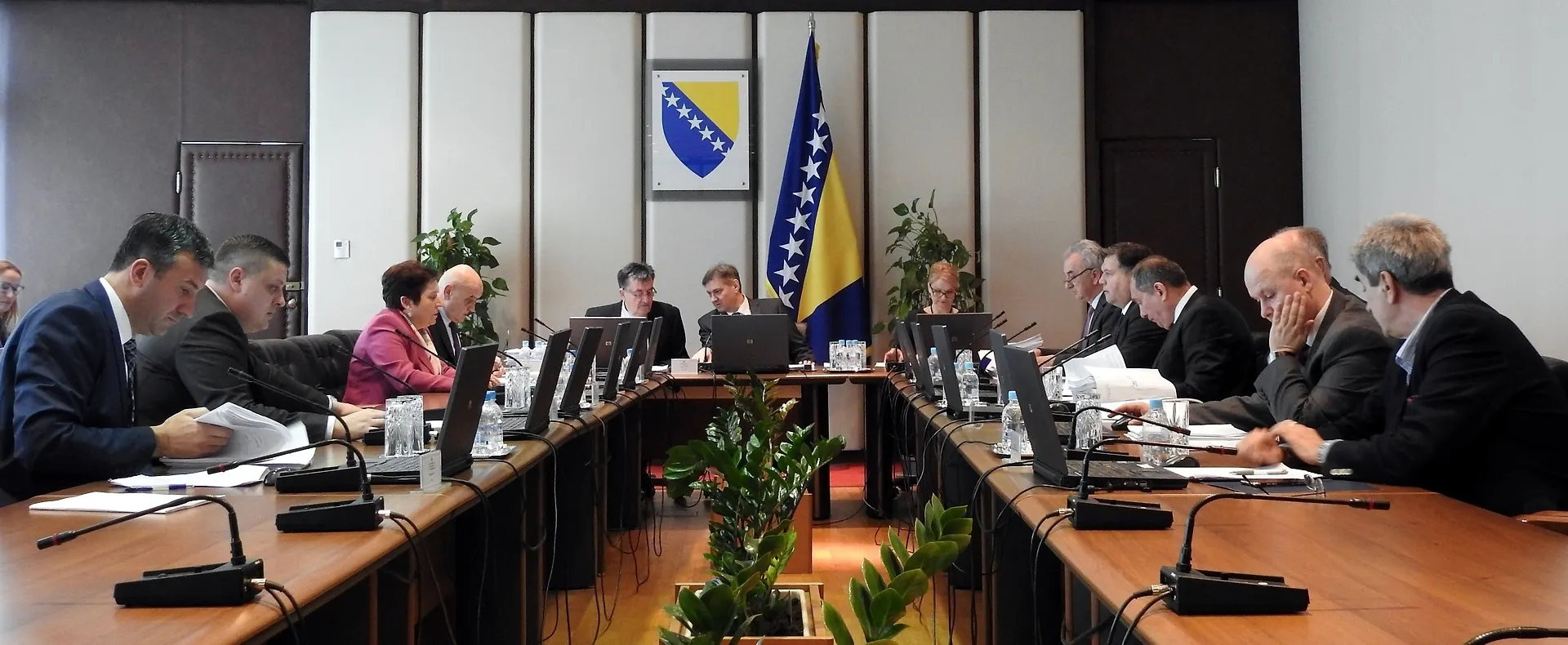
Council of Ministers of Bosnia and Herzegovina Holds Its 90th Session
02/02/2017
Vijeće ministara Bosne i Hercegovine
The Council of Minister of BIH adopted its Work Programme for year 2017, with some corrections made at the session, which Programme contains about 100 development-investment projects and is focused to the EU accession, fulfilment of requirements under the “Partnership for Peace” and further promotion of regional and international cooperation.
The Council of Ministers Work Programme contains an Action Plan with designated holders of activities and implementation deadlines; overview of over 40 laws and about 650 other acts (resolutions, reports, information, analyses, strategies, international contracts and other documents) to be on the Council of Ministers’ agenda in 29017, in addition to development-investment projects/programmes.
The annual programme is based on a Mid-Term Work Programme of the Council of Ministers of BIH, which relies the Bosnia and Herzegovina development vision on five general development principles (integrated growth, smart growth, sustainable growth, inclusive growth, growth-oriented governance), thereby linking the Council of Ministers of BIH operations with the “Europa 2020” and “SEE 2020” Strategies.
The Council of Ministers’ 2017 agenda will include the justice sector development laws, which stem from the Structural Dialogue of BIH with the EU and obligations under the Stabilisation and Accession Agreement, then several laws from the area of communications, new laws on food and veterinary service, on foreign affairs, on rights of torture victims in BIH, n Foreigners’ Affairs Service, on drugs and medical appliances, on civil service and other laws, aiming their harmonisation with the EU legislation.
The adoption of several strategies was planned, namely, strategy for fight against organised crime in Bosnia and Herzegovina, for supervision over narcotics, on BIH health system reform, as well as adoption of a mid-term strategy of BIH debt management and promotion of a legal framework for cooperation with Diaspora by way of adoption of a policy and strategy on cooperation with BIH emigration.
An important work segment will be to strengthen cooperation and partnership at regional and international levels, to be followed by conclusion of a series of bilateral agreements, as well as intensification of joint projects with NGOs in BIH.
Negotiations for accession of Bosnia and Herzegovina to the World Trade Organisation (WTO) will continue in 2017.
GROWTH OF INDUSTRIAL OUTPUT
The Council of Ministers of BIH took note of Information of the Directorate for Economic Planning on macroeconomic trends for January-October 2016.
The BIH industrial production in the reported period of time was increased or 3.8 per cent in relation to the same period 2015, and the major monthly increase was in February standing at 7.3 per cent. The export-oriented procession industry, with its output increase of 3.2 per cent, represents the main growth leverage, together with power generation and mining sectors, which market an increase of 6.1 per cent and 2.9 per cent, respectively, compared with the same period 2015. Viewed by the branches, highest growth rates were made in the furniture production – 15.3 per cent, chemicals and final metal products – about 13 per cent, food and wood products – about 9 per cent and 6 per cent, respectively, in comparison with the same period a year before.
September 2016 marked 733.3k employees in BIH, which is 2 per cent more than in the same month 2015. The number of registered unemployed persons in October 2016 was 512.5k and was decreased for 4.5 per cent at the annual level. The major contribution to the growth of employment was made in the areas of wholesale and retail sale trade, overhauls of motor vehicles and processing industry.
The total size of deposits at the end of September was KM 17.2 billion, while citizens’ deposits increased by 6.6 per cent as at end September.
The foreign trade goods deficit of BIH in January-October 2016 was KM 5.551 billion, and was decreased by 3.2 per cent, relative to the same period the year before. BIH exported goods worth KM 7.692 billion in the first ten months of 2016, which represents an increase for 2.6 per cent, compared to the same period last year, while the import stagnated and was KM 13.243 billion.
PROTECTION OF CONSUMERS’ RIGHTS IN BIH
The Council of Ministers of BIH took the Ministry of Foreign Trade and Economic Relations-proposed Decision on adoption of a 2017 State Annual Consumer Protection Programme in Bosnia and Herzegovina, prepared by the BIH Consumer Protection Council.
The Programme provides for a set of measures to be taken by competent institutions at the State, entity d Brčko District of BIH levels for the sake of improvement of quality of life of all citizens of Bosnia and Herzegovina and health and consumer safety awareness rising. Aims of the Programme are, among other things, further harmonisation of BIH legislation with that of the European Union in the area of consumer protection, creation of conditions for an effective dealing with spotted consumer protection problems, consumer empowering at the market and their awareness rising as to their rights and role in the economy.
The State Annual Consumer Protection Programme in 2017 is a comprehensive document, which creates the consumer protection policy, defines priorities, sets forth measures for their implementation, and defines holders of activities for meeting planned aims and tasks.
TO IMPROVE DATA COLLECTION SYSTEM IN EDUCATION
The Council of Ministers of BIH adopted Information of the Ministry of Civil Affairs on development of a document “Guidelines for development of statistical reporting in education”, with a view at harmonisation of the process with international standards and requirements of the European Union.
The Ministry of Civil Affairs of BIH will continue its cooperation with all relevant institutions for the aim of improvement of statistical reporting in the area of education.
The guidelines will enable a considerable improvement of the data collection system, together with smooth proof-based policy planning and improved BIH reporting as per tis international obligations. These will also serve to recognise sources and ways of data collection, necessary for development of strategic documents for secondary vocational education and training in BIH, as well as other strategic documents in the area of education and training.
TO HARMONISE LAWS WITH FRAMEWORK LAW ON HIGH EDUCTION
The Council of Ministers of BIH adopted information of the Ministry of Civil Affairs on the implementation of the Framework Law on High Education I Bosnia and Herzegovina in 2016.
The Council of Ministers of BIH pointed to the competent education authorities at the obligation of harmonising the existing high education laws with the Framework Law on High Education in Bosnia and Herzegovina, with a focus to respect for academic liberties, academic self-governance and autonomy of high education institutions.
The competent high education authorities and secondary education institutions need to start, as soon as possible, together with the Agency for High Education Development and Quality Insurance, their activities on the process of accreditation of study programmes at all high education institutions in Bosnia and Herzegovina.
The Council of Ministers of BIH tasked the relevant Agencies, namely, the Agency for High Education Development and Quality Insurance and Centre for Information and High Education Documents Recognition to continue fulfilling their obligations and activities from the Framework Law on High Education in BIH.
The Ministry oif Civil Affairs will provide Information on the Implementation of Framework Law on High Education in Bosnia and Herzegovina for 2016 to the Entity and Cantonal Ministries of Education and Assemblies, Education Department of the Brčko District of BIH, Agency for High Education Development and Quality Insurance and to Centre for Information and High Education Documents Recognition.
TO CREATE EFFECTIVE LABOUR MARKET IN BIH
The Council of Ministers of BIH adopted Information of the Directorate for European Integrations, with some corrections made at the session, on activities implemented concerning planning and programming of assistance though sector budget support within IPA 2017 – Employment Sector.
These activities on drafting of an Action Document – Sector Reform Contract for Employment, Education and Welfare policy for sector budget support within IPA 2017, which aims to facilitate the creation of an effective labour market in BIH. The concrete aims include the increase of employment of youth, disabled persons and long-term unemployed persons, increase of women participation in employment and at labour market, improvement of quality and effectiveness of institutions and services responsible for labour market, and increase of employability though adjustment of education system to labour market demands, with a special focus further development and implementation of the Qualification Framework of BIH.
BIH PARTICIPATES IN SIX IPA II 2014-20020 TERRITORIAL COOPERATION PROGRAMMES
The Council of Ministers of BIH adopted Information on progress in implementation of the IPA I and IPA II cross-border/territorial cooperation programmes for 2016, prepared by the Directorate for European Cooperation.
According to Information, Bosnia and Herzegovina takes part in six programmes within the second IPA component 2007-2013, out of which three bilateral with the neighbouring countries: Croatia, Montenegro and Serbia, IPA Adriatic Cross-Border Cooperation Programme, and SEE and MED, the two transnational programmes. The aims, priorities and measures of each of the programmes were defined in the relevant programme documents, approved by the European Commission in 2007.
Within IPA II 2014-2020, BIH participated in six territorial cooperation programmes. These are two bilateral programmes (BIH and Montenegro and BIH and Serbia), one trilateral cross-border cooperation programmes (Croatia-BIH-Montenegro) and three transnational programmes (Danube, Adriatic-Ionian and Mediterranean Programmes). The aims, priorities and measures of each of the programmes were defined in the relevant programme documents, approved by the European Commission in the end 2014 and in 2015.
All these programmes are being implemented by way of periodically issued public calls for submission of project proposals.
(end)